What is the discovery phase of the construction contract lifecycle? The discovery phase is the critical initial stage where project owners evaluate the technical feasibility, commercial viability, and strategic risks of a concept before contractor engagement. It involves alternatives analysis, front-end planning, business case development, and establishing go/no-go decision gates to ensure strategic alignment.
Table of Contents
For construction project managers, commercial managers, and those preparing for the Project Management Institute Construction Professional (PMI-CP) certification, mastering this phase isn’t just an administrative check-the-box exercise. It is a strategic imperative that dictates whether a project will succeed or fail. Let’s dive into the core mechanics of the Discovery Phase of The Construction Contract Lifecycle, how it dictates your project delivery methods, and how to leverage it to engineer risk out of your next capital project.
The Five Stages of the Construction Contract Lifecycle
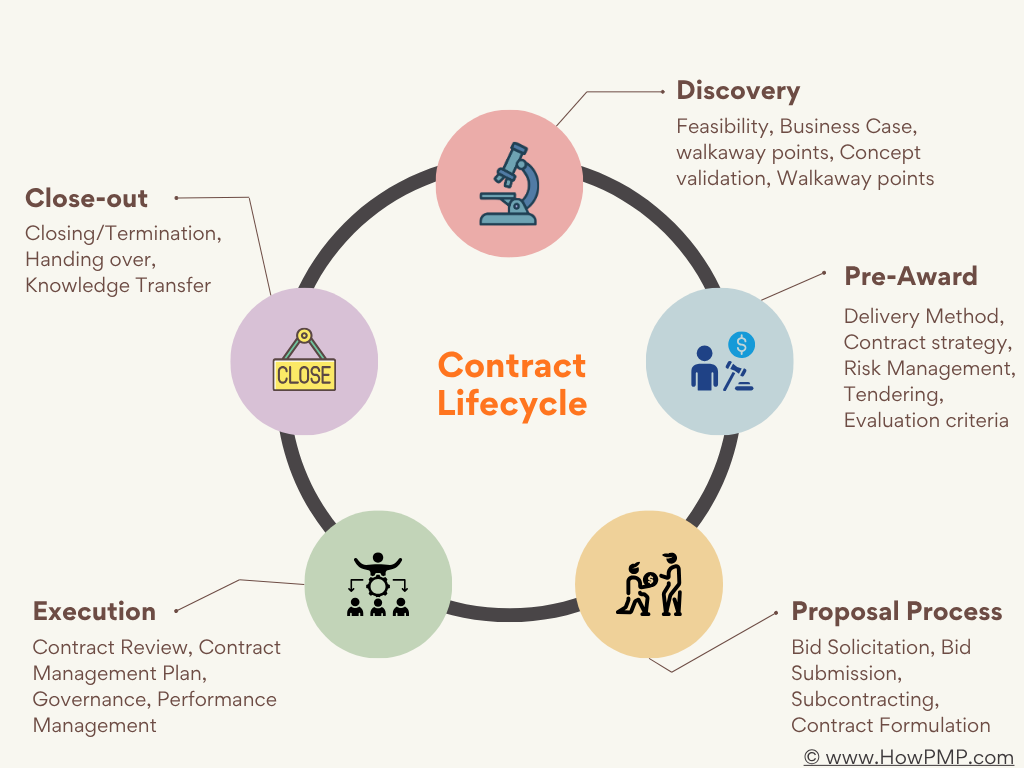
To fully comprehend the strategic weight of the discovery phase of the construction contract lifecycle, we must contextualize it within the broader continuum of a capital project. The construction contract lifecycle comprises five distinct, sequential stages:
- Discovery,
- Pre-Award,
- Proposal Process,
- Contract Execution and Management, and
- Contract Closeout.
While execution gets the lion’s share of attention, the discovery phase is where the highest degree of value engineering and risk mitigation happens. It is the period where the “what” and the “why” of a project are defined, leaving the subsequent stages to manage the “how” and the “who.”
| Lifecycle Stage | Core Objective | Key Practitioner Role |
| 1. Discovery | Validate project concept and feasibility. | Lead market studies, assess risk, and establish ROI. |
| 2. Pre-Award | Finalize procurement strategy and delivery method. | Advise stakeholders on contract structures. |
| 3. Proposal Process | Solicit and evaluate market responses. | Execute rigorous evaluation against pre-defined criteria. |
| 4. Execution & Management. | Deliver the physical asset according to contract. | Mitigate communication gaps, manage claims. |
| 5. Closeout | Transition asset to operations and finalize finances. | Ensure proper documentation, capture lessons learned. |
Once discovery insights are complete, the practitioner formally transitions the initiative into the pre-award phase to finalize the contracting strategy and tender documentation.
Discovery Phase of the Construction Contract Lifecycle
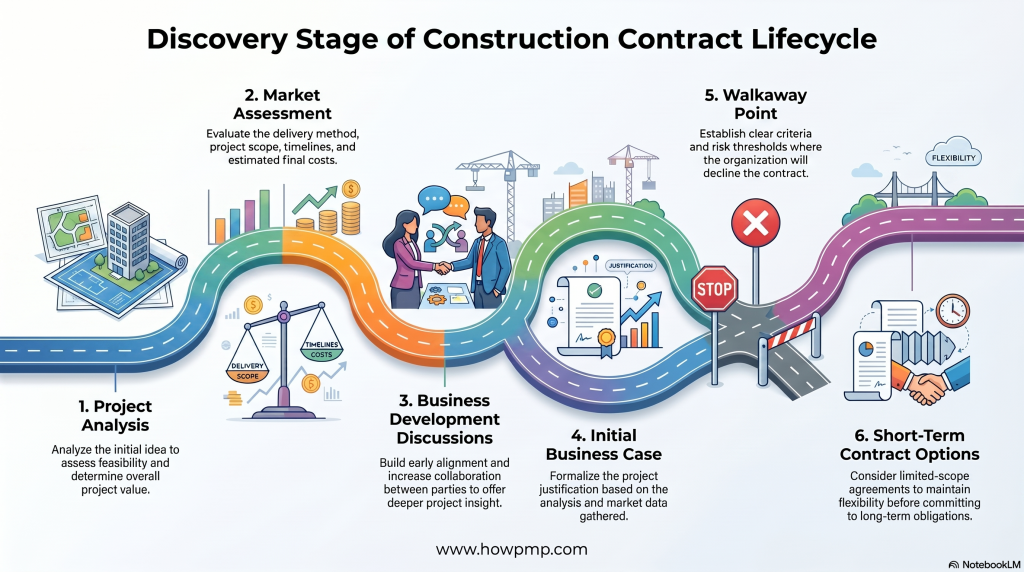
The Discovery Phase of The Construction Contract Lifecycle is virtually synonymous with Front-End Planning (FEP). This collaborative, diagnostic period goes far beyond traditional schematic design. It requires taking the time to fully understand operational requirements, business objectives, and the critical success factors governing the project’s lifespan. FEP operates as the overarching philosophy, while the discovery phase itself is structurally defined by the PMI-CP framework through six interdependent steps.
These six steps function as a diagnostic funnel, systematically reducing uncertainty and transforming abstract concepts into executable, de-risked work packages.
Step 1: Project Analysis and Feasibility
The Discovery Phase of The Construction Contract Lifecycle initiates with Project Analysis. During this stage, the owner or owner’s representative conducts an initial idea analysis to assess spatial, technical, and environmental feasibility. The primary objective is to determine the project’s organizational value and ensure that the envisioned physical asset perfectly aligns with the sponsoring organization’s long-term strategy.
Project analysis involves alternatives analysis, wherein project owners explore a spectrum of options to achieve their organizational goals. This may involve comparing greenfield developments against retrofitting brownfield sites, evaluating zoning restrictions, and conducting Environmental Impact Assessments (EIA). Once an alternative is selected, technical feasibility (geotechnical conditions, utility infrastructure) and commercial feasibility (CAPEX/OPEX budgets) are heavily scrutinized.
A premier example of evolving project analysis within the discovery phase is Masdar City in Abu Dhabi. Originally envisioned as a completely zero-carbon, car-free urban utopia, the initial project analysis encountered severe pragmatic limitations in the wake of global financial shifts. Through rigorous reassessment during the discovery phase, the project’s objectives were recalibrated. The analysis demonstrated that maintaining absolute zero-carbon status across a 6-square-kilometer development was commercially unfeasible with existing technologies and capital constraints.
Consequently, the project analysis pivoted the objective to a highly efficient “low-carbon” model. This vital adjustment allowed third-party developers to participate, ensuring commercial viability while still maintaining an aggressive 40% reduction in baseline energy and water consumption compared to ASHRAE standards. By executing this level of project analysis early, the master developers prevented the initiative from becoming a stranded asset. They validated the use of the Estidama Pearl Building Rating System (mandating a minimum 3-Pearl rating) to govern subsequent technical designs, ensuring that sustainability goals were balanced with economic reality.
Step 2: Market Assessment and Benchmarking
Once the internal project analysis defines the desired asset, the focus shifts externally to Market Assessment. This step requires gathering early benchmarking data regarding project duration, capital expenditure (CAPEX), and supply chain capacity. Market assessment relies heavily on historical project data, analyzing previous delivery methods, final scopes, and realized timelines to determine whether the proposed project is feasible within current market conditions.
In highly active construction markets, macroeconomic volatility can render early conceptual budgets obsolete within months. A robust market assessment must track commodity pricing, labor availability, and regulatory shifts. For instance, in the United Arab Emirates, the construction consulting market is deeply influenced by federal initiatives like the “Projects of the 50” and the Dubai 2040 Urban Master Plan, which collectively sustain a USD 700 billion capital pipeline. Abu Dhabi’s AED 106 billion (USD 28.9 billion) Emirati housing initiative alone has driven massive integrated design work.
During market assessment for UAE-based mega-projects, cost estimators must benchmark the extreme volatility of core materials. Data indicates that deformed rebar prices have experienced year-on-year swings of up to 18%, while ready-mix concrete pricing hovers around AED 268 per cubic meter. Because materials account for nearly half of total build costs, static feasibility models rapidly become outdated.
Furthermore, market assessments must account for new regulatory mandates, such as Dubai’s Building Information Modeling (BIM) requirements, which integrate digital twin delivery and consequently raise design-phase consulting fees by 15% to 25%. By conducting this assessment during the Discovery Phase of The Construction Contract Lifecycle, project owners can embed appropriate contingencies into their budgets rather than discovering critical supply chain deficits during the proposal process.
Step 3: Business Development Discussions
Following the quantification of market constraints, the project enters the Business Development Discussions step. This phase represents the earliest formal interaction between the project owner and potential contracting entities. A major, often highly interactive component of the Discovery Phase of The Construction Contract Lifecycle involves direct market engagement to align expectations and build foundational trust, which acts as a primary defense against future litigation.
Rather than adversarial negotiation, these discussions are collaborative and diagnostic. Owner organizations utilize this time to screen potential contractors, gather industry input regarding the proposed design, and identify high-risk execution areas. Conversely, contracting entities focus on developing relationships, performing preliminary due diligence, and gently influencing project specifications to align with their operational strengths.
These discussions are critical for establishing constructability parameters and Interface Management protocols. Megaprojects inherently possess massive interface risks, points where different contractors, structural systems, or design packages intersect.
The construction of the Zayed National Museum and the Guggenheim Abu Dhabi on Saadiyat Island perfectly illustrates the necessity of this step. The Guggenheim, designed by Pritzker Prize–winning architect Frank Gehry, features highly complex asymmetrical cones inspired by traditional Emirati wind towers, requiring the integration of steel, concrete, wood, and aluminum across 80,000 square meters. Similarly, the Zayed National Museum, designed by Lord Norman Foster, features five vertical steel wings reaching up to 130 meters tall, fabricated from 13,000 tonnes of architectural exposed steel (AES), alongside four 500-tonne gallery pods.
For the BESIX and Trojan General Contracting Joint Venture executing these structures, early business development discussions were mandatory. The sheer complexity of erecting 130-meter steel wings that double as solar thermal chimneys required the contractors and the Department of Culture and Tourism to engage in extensive dialogue regarding construction sequencing, crane logistics (including the use of one of the world’s largest cranes to position the pods), and full BIM integration long before standard mobilization could occur.
Step 4: Developing the Initial Business Case
The culmination of project analysis, market assessment, and early discussions is the formulation of the Initial Business Case. This document justifies proceeding with the capital expenditure and acts as the project’s economic anchor. It translates engineering parameters and technical scopes into corporate finance metrics, such as Net Present Value (NPV), Internal Rate of Return (IRR), and payback periods. Before full project mobilization, this rigorous business case evaluates overall feasibility and return on investment, guiding the final decision-making of senior stakeholders.
A masterclass in dynamic business case development within the Discovery Phase of The Construction Contract Lifecycle is the Etihad Rail megaproject. Initially conceived and operationalized in Stage One as a heavy freight network transporting granulated sulphur from Shah and Habshan to Ruwais, the business case was primarily anchored in industrial logistics, moving 22,000 tonnes of sulphur daily. However, as the network expanded into a 1,200-kilometer system, the discovery phase for subsequent stages necessitated a radical expansion of the initial business case to include nationwide passenger transit.
The revised business case quantified the socioeconomic ROI of linking 11 cities across the UAE. Feasibility studies projected that integrating passenger transit would serve 36.5 million passengers annually by 2030, drastically reducing road traffic emissions and cutting commute times by 30% to 40%. The business case evaluated the integration of high-speed passenger rail (reaching speeds of up to 350 km/h) and standard passenger services (200 km/h) that would cut the Abu Dhabi to Dubai commute to 30 and 57 minutes, respectively.
With passenger services slated to launch an introductory operational phase on June 30, 2026, the underlying business case successfully justified the AED 1.6 billion systems and integration contract awarded to Hitachi Rail STS. This contract equips the network with the European Train Control System (ETCS) Level 2 signaling, an 800-km 11 kV power distribution network, and a unified operational control center at Faya. By comprehensively modeling these technological and socioeconomic benefits during discovery, stakeholders confidently approved a project that reshapes the UAE’s economic geography.
Step 5: Establishing Walkaway Points
A critical, yet frequently overlooked, psychological and financial mechanism within the Discovery Phase of The Construction Contract Lifecycle is the establishment of the Walkaway Point. During early negotiations and planning, designers, contractors, and subcontractors must objectively define their absolute thresholds for participation. A walkaway point is a predefined limit based on unacceptable risk allocation, insufficient profit margins, extreme scope complexity, limitations in technical expertise, or compressed timescales. Margin erosion and unmitigated risk transfer are typically the primary drivers for triggering a walkaway point.
For project owners, the walkaway point might be a CAPEX threshold that destroys the Initial Business Case’s NPV. For contractors, it is often tied to the transfer of unquantifiable risk.
Real-World Project Example: The Geotechnical Walk-Away
During early business development discussions for a complex underground rail extension, a tier-one contractor reviewed the owner’s initial conceptual scope. The owner insisted that all unknown geotechnical risks (including potential archaeological discoveries and subterranean water tables) be borne entirely by the contractor without schedule relief. Recognizing that this severely violated their internal margin and risk thresholds, the contractor triggered their predefined “walk-away point.” They formally declined to participate in the pre-award phase, saving themselves from an unbalanced, high-risk contract that carried a high probability of catastrophic financial loss.
Defining these parameters early prevents the destructive phenomenon of the “winner’s curse,” where a contractor wins a bid by underpricing risk, leading to inevitable claims, adversarial relations, and potential project abandonment. Establishing walkaway points ensures that only balanced, equitable contracts transition into the pre-award phase.
Step 6: Short-Term Contract Options
To mitigate the unknowns identified in the first five steps, owner organizations increasingly utilize Short-Term Contract Options before committing to the primary execution contract. Also referred to as early works agreements, Front-End Engineering Design (FEED) contracts, or Pre-Construction Services Agreements (PCSAs), these short-term instruments authorize project validation, site investigation, or interim design work.
The strategic goal of a short-term contract is to allow contractors to physically investigate weaknesses, ground conditions, constructability issues, and optimal delivery methods without requiring the owner to commit substantial capital or resources to the entire asset lifecycle.
The construction of the Guggenheim Abu Dhabi serves as a prime example of effective short-term contracting. Before the main construction contract was awarded to the BESIX and Trojan JV to build the superstructure, the foundations of the museum were already completed under a separate, preceding contract. By splitting the foundation work into an early short-term contract, the owner (Department of Culture and Tourism) successfully de-risked the geotechnical unknowns of building on Saadiyat Island, a marine environment. Once the foundation was secured, the residual risk for the main superstructure was significantly lowered, allowing the primary contractors to optimize their planning, methods, and procurement for the highly complex Frank Gehry-designed cones without the threat of subsurface delays.
Strategic Risk Management and the IPRA Framework
Because the construction industry is inherently volatile, the Discovery Phase of The Construction Contract Lifecycle must focus intensely on strategic risk management. Risk identification at this stage captures both macro-economic shifts and tactical risks, like localized labor shortages or regulatory changes. The data compiled during the discovery phase informs how risks are categorized, prioritized, and mitigated.
The Integrated Project Risk Assessment (IPRA)
A cornerstone of discovery-phase risk management is the Integrated Project Risk Assessment (IPRA). Originally developed by the Construction Industry Institute (CII) to assist project teams in assessing complex projects in unfamiliar jurisdictions, the IPRA provides a structured, objective process for identifying critical risk factors across technical, economic, regulatory, and cultural spectrums.
Subjectivity is the enemy of accurate early-stage planning and cost modeling. To combat this, the IPRA utilizes a unified, standardized Likert scale to quantify the likelihood and impact of risks. When combined with advanced probabilistic tools like Monte Carlo simulations, the IPRA allows project managers to model thousands of potential outcomes based on variable inputs. This generates a probabilistic forecast (e.g., a “P70” confidence level that the project will complete under $500M) rather than relying on flawed, deterministic fixed-timeline assumptions.
If Monte Carlo simulations reveal a 40% probability of missing the project deadline or exceeding the budget, the team can develop targeted contingency plans and risk response strategies before the contract is signed. Regularly updating the IPRA tool to capture emerging risks during the discovery phase ensures that the risk register remains a living document that continually refines the Initial Business Case.
Aligning Project Delivery Methods During Discovery
The data compiled in the Discovery Phase of The Construction Contract Lifecycle, specifically the IPRA results, the short-term contract findings, and the owner’s documented risk appetite, directly dictates the most consequential decision of the pre-award phase: the selection of the Project Delivery Method.
Different delivery methods shift the burden of cost, schedule, and design risk between the owner and the contractor. The PMI-CP framework identifies several core models that must be explicitly aligned with project characteristics during the transition out of the Discovery Phase of The Construction Contract Lifecycle:
| Delivery Method | Risk Allocation & Optimal Use Case | PMI-CP Recommendation Context |
| Design-Bid-Build (DBB) | Owner holds design risk. Best when design is 100% complete before construction begins. Provides cost certainty via a lump-sum contract. | Apply when the process demands competitive bidding, fairness, and clear comparison of prices for a fully defined scope. |
| Construction Management at Risk (CMAR) | Transfers financial cost risk to the contractor above a Guaranteed Maximum Price (GMP). | Ideal when the owner wants design control but needs early advisory support regarding constructability and cost certainty. |
| Design-Build (DB) | Single point of accountability; contractor holds design and construction risk. | Select when speed to market is critical and the owner prefers a single point of accountability with reduced interface risk. |
| Integrated Project Delivery (IPD) | Shared risk and reward via an Integrated Form of Agreement (IFOA). | Adopt for complex projects requiring Lean practices, early collaboration, and the elimination of operational silos. |
| Project/Construction Management (PCM) | Owner retains all cost exposure; manager acts purely as an agent for a fee. | Use when the owner lacks internal staff and needs an expert to manage multiple contracts on their behalf. |
| Build-Operate-Transfer (BOT) | Private party finances, builds, and operates the facility before transferring it back to the owner. | Identify when long-term lifecycle accountability and private financing are required. |
Selecting the incorrect delivery method during the transition from discovery to pre-award is a leading cause of project failure.
Real-World Project Example: The Healthcare Mega-Project
A hospital network planning a $500M facility expansion utilized the discovery phase to assess their risk appetite. The IPRA highlighted massive technological integration risks involving advanced medical imaging equipment and smart-building HVAC systems. Realizing a rigid, adversarial, and siloed Design-Bid-Build contract would lead to catastrophic claims and delays, the senior leadership chose an Integrated Project Delivery (IPD) method. Because they identified this need during discovery, they successfully drafted an IFOA that incentivized the design and construction teams to share the risk and innovate collaboratively.
Interface Management and Communication Infrastructure
Fragmented communication is a leading cause of project failure. To mitigate this, the discovery phase of the construction contract lifecycle is when the communication infrastructure must be established.
This involves planning a centralized Project Management Information System (PMIS) and incorporating Lean construction concepts like the “Big Room” (Obeya) to drive cross-functional decision-making. Setting up these logistics and cultural rules before contracts are awarded ensures the team operates efficiently the moment execution begins.
Discovery Readiness and Claims Prevention
A frequently overlooked value of the discovery phase is establishing a robust data governance policy. The construction sector generates vast quantities of data (BIM files, RFIs, daily logs). Should the project enter litigation during execution, the party that can efficiently locate and retrieve records has a decided advantage.
A legally defensible data deletion and retention policy crafted during the project’s discovery phase formalizes what information must be archived and what can be routinely purged, significantly reducing the exorbitant costs associated with chaotic information retention.
Establishing Go/No-Go Decision Gates
Because financial commitments scale exponentially as a project progresses, the discovery phase of the construction contract lifecycle culminates in formal stage-gate theory. Stage-gates are objective, data-backed checkpoints where sponsors review deliverables and make a definitive decision to proceed, pause, or terminate.
To keep emotion and internal politics out of the decision, the criteria for the “Go / No-Go” gate must be rigorously defined by the Initial Business Case.
Discovery Phase of The Construction Contract Lifecycle: Go/No-Go Checklist
Use this diagnostic checklist to evaluate if a project is ready to exit the Discovery Phase of The Construction Contract Lifecycle:
- [ ] Technical Feasibility: Site conditions evaluated; environmental/zoning confirmed.
- [ ] Commercial Viability: ROI confirmed; initial CAPEX/OPEX budgets established.
- [ ] Risk Assessment: IPRA completed; mitigation strategies modeled and funded.
- [ ] Stakeholder Alignment: External regulatory bodies engaged; walk-away points defined.
- [ ] Delivery Strategy Readiness: Optimal delivery method (e.g., IPD, CMAR) identified based on the owner’s documented risk appetite.
PMI-CP Certification: Mastering the Discovery Phase of The Construction Contract Lifecycle
For professionals pursuing the PMI Construction Professional (PMI-CP) certification, deep knowledge of the Discovery Phase of The Construction Contract Lifecycle is explicitly required.
Under Domain 1 (Contracts Management) of the PMI-CP Exam Content Outline, candidates are tested on their ability to oversee the contract lifecycle specifically from discovery to closeout. You are expected to know how to:
- Mobilize Risk Frameworks: Mobilize a risk management framework at the project’s absolute outset using the IPRA tool and Monte Carlo simulations.
- Advise on Delivery Methods: Use the insights generated during the discovery phase to confidently advise senior leadership on whether traditional structures or collaborative models (like Lean IPD and IFOA) best fit the project’s needs.
- Establish Walk-Away Points: Identify thresholds regarding risk, margin, and scope that protect your organization from unbalanced agreements.
Understanding that these strategic decisions happen before the pre-award phase is a fundamental competency of a PMI-CP credential holder.
Lessons Learned: The Cost of Bypassing Discovery
Accepting a construction contract based on fuzzy conceptual scopes is like signing a contract to build a house based solely on the square footage, ignoring the soil conditions, the plumbing requirements, and the roof type.
When a project skips discovery and relies on fixed costs built upon incomplete assumptions, it becomes highly vulnerable to massive scope creep, adversarial change order battles, and deep confusion around project priorities. Failing to conduct a market assessment leaves the project exposed to sudden material price shocks, while ignoring interface management guarantees that clashes will occur in the field rather than on a BIM screen.
By insisting on a rigorous discovery process, you protect capital investments, ensure timelines align with realistic market conditions, and transform abstract ideas into fully prioritized, de-risked work packages. The lessons learned from troubled projects consistently point back to a lack of investment in front-end planning and an eagerness to break ground before the business case was truly validated.
Conclusion
The discovery phase of the construction contract lifecycle transforms conceptual ambition into executable strategy. By enforcing rigorous front-end planning, utilizing quantitative risk assessments like the IPRA, and establishing objective go/no-go phase gates, construction professionals can systematically engineer risk out of a project before any binding commitments are made.
Whether you are preparing for your PMI-CP exam or stepping into a commercial management role on a megaproject, remember: a successfully executed discovery phase does not merely initiate a project; it secures its successful conclusion.
Frequently Asked Questions (FAQ)
1. What is the discovery phase of the construction contract lifecycle? The discovery phase is the critical initial stage where project owners evaluate the technical feasibility, commercial viability, and strategic risks of a concept before contractor engagement. It utilizes front-end planning, market assessments, and business case development to establish go/no-go decision gates. It represents the period where the foundational “what” and “why” of the project are defined before moving into the pre-award procurement stage.
2. What are the six steps of the Discovery Phase of The Construction Contract Lifecycle according to PMI-CP? The PMI-CP framework breaks the discovery phase down into six steps: 1) Project Analysis (evaluating feasibility and strategy), 2) Market Assessment (benchmarking costs and supply chain constraints), 3) Business Development Discussions (early market engagement and screening), 4) Initial Business Case (justifying the investment and ROI), 5) Walkaway Point (defining thresholds for unacceptable risk or margin erosion), and 6) Short-Term Contract Options (using early works agreements for validation).
3. How does the Discovery Phase of The Construction Contract Lifecycle impact the selection of a project delivery method? The data gathered during discovery, specifically the owner’s risk appetite, the market assessment, and the Integrated Project Risk Assessment (IPRA) results, dictates the optimal delivery method. For example, high-risk, highly integrated projects might require an Integrated Project Delivery (IPD) model with shared risk, whereas projects with fully completed designs and low risk are better suited for traditional Design-Bid-Build.
4. What is the Integrated Project Risk Assessment (IPRA) tool? Developed by the Construction Industry Institute (CII), the IPRA is a structured risk management framework used heavily during discovery. It helps project teams identify, quantify, and mitigate complex technical, environmental, and economic risks using a unified Likert scale and probabilistic forecasting tools like Monte Carlo simulations.
5. Why are “Walk-Away Points” critical in the Discovery Phase of The Construction Contract Lifecycle? Walk-away points establish predefined, objective thresholds regarding unacceptable risk, compressed schedules, or insufficient profit margins. Identifying these during early discussions prevents owners and contractors from succumbing to the “winner’s curse” and entering into unbalanced, financially ruinous contracts.
6. What happens if a construction project skips the Discovery Phase of The Construction Contract Lifecycle? Bypassing discovery leads to contracts based on fuzzy specifications and unvalidated assumptions. This predictably results in severe scope creep, massive change order disputes, misaligned stakeholder expectations, and a high probability of litigation. Ultimately, skipping this phase severely jeopardizes the project’s timeline and the organization’s capital investment.